


Erik Lindqvist, Features Reporter.
There is a particular kind of frustration that shows up around eleven in the morning: the T-zone has gone shiny, the cheeks look dry and patchy where the foundation has settled into fine lines, and the reflection in the office bathroom mirror bears only a passing resemblance to the one that left the house at eight. Most women with combination skin know this moment well, and most have a small graveyard of half-used foundation bottles under the sink to show for it, each one promising an all-over solution to a face that behaves like two different climates.
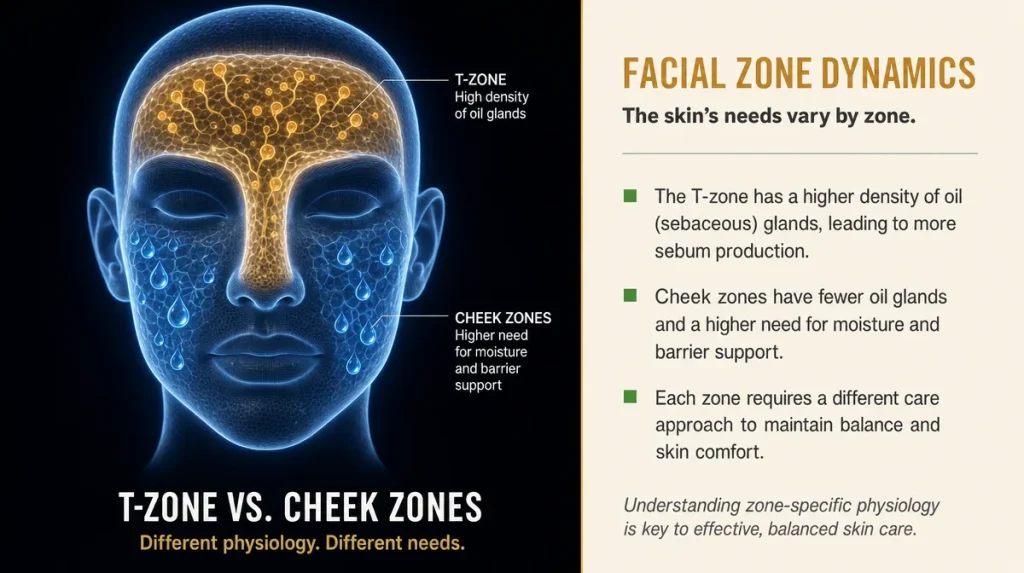
The useful fact to start with: your T-zone and your cheeks are not just oilier or drier, they have measurably different numbers of sebaceous glands per square centimetre, which is why one finish rarely suits both. Once that clicks, foundation shopping stops being trial and error and starts being a short, logical process. This guide walks through that process from undertone to finish to application, what genuinely matters and what is simply packaging language, so the next bottle you buy is the last one you need for a while.
- Combination skin needs a finish strategy, not a single product: the T-zone and cheeks have different oil output, so judging one foundation by how it looks in one zone alone is the most common buying mistake.
- Undertone matters more than shade name: warm, cool and neutral undertones are visible in daylight on the jaw, not under shop lighting, and matching this first narrows any counter or catalogue by roughly two-thirds.
- A foundation needs a full day and one humid or hot stretch to prove itself: oxidation and oil breakthrough both take hours to show, so judging a match in the first ten minutes wastes the return window most retailers allow.
Why One Bottle Rarely Works Everywhere On Your Face

Combination skin is not a compromise category invented by marketing departments. Dermatological texts describe it plainly: the forehead, nose and chin sit over a denser concentration of sebaceous glands than the cheeks and jaw, so those zones produce visibly more sebum by midday, particularly in warmer months. The cheeks, meanwhile, often sit closer to normal or dry, especially through a Nordic or central European winter when indoor heating strips moisture from the air.
Think of it the way a plumber thinks about water pressure in an old building: the pipes nearest the boiler run hot and fast, the ones furthest away run cooler and slower, even though it is the same system. A single foundation formulated for one pressure setting will always struggle at the other end of the house.
This is why a foundation that looks flawless in a shop mirror at ten in the morning can look entirely different by four in the afternoon: the test conditions were only ever describing one zone of the face, usually the cheek, because that is where a consultant applies the sample.
Finding Your Undertone In Daylight
Shop lighting, particularly the warm downlights used in many department store beauty halls, shifts colour perception enough to make a cool-toned foundation look neutral or even warm. The reliable method is simpler and costs nothing: stand near a window in natural daylight, without makeup, and look at the underside of your jaw and the inside of your wrist together.
Greenish or olive undertones in the veins usually indicate a warm undertone. Blue or purple veins point to cool. If it is genuinely hard to tell, or the veins look a mix of both, you are likely neutral, which is more common than the beauty industry’s shade-naming conventions suggest.
A quick self-test: hold a piece of plain white paper under your chin in daylight. Skin that looks slightly yellow or golden against the white leans warm; skin that looks pink or rosy leans cool. This single check, done properly in daylight rather than under shop lighting or a phone flash, eliminates most of the guesswork before you even open a bottle.
Reading A Label Without The Marketing Noise
Foundation packaging is dense with language designed to sound scientific without necessarily being useful. “24-hour wear” describes a laboratory test condition, not a guarantee for a face that produces oil unevenly across its surface. “Skin-loving ingredients” is not a regulated term in the EU and carries no defined threshold.
What actually matters for combination skin sits lower on the ingredient list, in the first third: whether the formula uses silica or clay-based powders (these absorb oil, useful for the T-zone) versus glycerin or hyaluronic acid further up the list (these hold water, useful for drier cheeks). A foundation that lists both, in that order, is usually built with combination skin in mind, whatever the marketing copy on the front says.
SPF is worth checking separately from the wear claims. An SPF 15 or 20 embedded in a foundation is rarely sufficient as a day’s only sun protection, particularly given how much of the face a typical application actually covers evenly. Dermatologists writing in European journals have repeatedly noted that foundation SPF should be treated as a top-up to a proper sunscreen, not a replacement for one, a point Cosmetics Europe’s public guidance on sun protection also makes in its general consumer advice.
The Patch Test And The Twenty-four-hour Rule
The single most skipped step, and the one that causes the most returned bottles, is the patch test. Apply a small amount along the jawline, not the back of the hand, and leave it through a normal day, including any exercise or heat exposure that day happens to bring.
Two separate things are being tested here. The first is oxidation: many foundations shift half a shade darker or slightly more orange within one to two hours as they react with the skin’s own oils, a documented effect in cosmetic chemistry that shop testers, applied and checked within minutes, cannot reveal. The second is genuine tolerance, since fragrance and certain preservatives are common triggers for contact irritation, something a clinical pharmacist would flag as worth checking before committing to a full bottle.
A fair test needs at least six hours, ideally through both an indoor and an outdoor stretch. Retailers including Douglas and Notino generally allow returns within a set window precisely because of this, so there is little reason to rush a verdict on day one.
Matte, Satin And The Myth Of All-over Control
Finish is where most combination-skin buyers go wrong twice: once by choosing a fully matte foundation because the T-zone shines by noon, and again by finding their cheeks look chalky and accentuate texture by evening.
A useful analogy is a kitchen worktop: a matte laminate hides fingerprints and grease brilliantly but shows every scratch and dry patch under bright light, while a satin or slightly glossy worktop reflects light evenly and disguises small imperfections, at the cost of showing smudges more readily. Skin behaves the same way. Fully matte formulas absorb oil well but sit unevenly on drier cheek texture, drawing attention to fine lines. Satin or semi-matte finishes reflect a small, even amount of light everywhere, which flatters drier zones but does less to control midday shine.
The practical answer for combination skin is rarely a single all-over matte or all-over dewy foundation, whatever the label promises. It is a satin or semi-matte base applied evenly, with a light dusting of translucent powder pressed only into the T-zone once the base has settled, roughly ten minutes after application. This zone-specific approach, rather than a single finish claim, is what actually holds up through a full day.
Tools That Change The Result More Than The Bottle Does
The same foundation applied with a synthetic brush, a damp sponge and bare fingers will produce three visibly different results, and this is worth understanding before blaming a formula for a poor match.
A damp sponge, bounced rather than dragged, deposits a thinner, more diluted layer because some product remains absorbed in the sponge itself. This suits drier cheek areas well. A dense synthetic brush deposits more product and buffs it into pores and fine texture, which gives fuller coverage but can look heavier over a naturally oily T-zone by midday. Fingers warm the product and blend it into the skin’s own oils fastest, which works well for a light, natural finish but offers the least precision for building coverage over redness or blemishes.
Many combination-skin routines benefit from using two tools rather than one: a slightly damp sponge over the cheeks for a soft, hydrated finish, and a smaller brush or fingertip pressed more firmly into the T-zone where oil control and coverage over open pores matter more. This costs nothing extra beyond owning both tools, and it solves more matching complaints than switching foundation formulas repeatedly does.
How Long To Judge A Foundation Before Giving Up On It
A common mistake is deciding a foundation is wrong within the first hour, often because the shade looks slightly off or the texture feels heavy while it is still settling. Most formulas need time to oxidise fully and to interact with the skin’s own oil production, which shifts through the day rather than staying constant.
A fair trial runs across at least three separate days, ideally including one warmer or more humid day and one cooler, drier day, since combination skin behaves differently in each. Note where the foundation breaks down first: if it is consistently the T-zone by early afternoon, the finish or oil-absorbing ingredients may need adjusting rather than the shade. If it is the cheeks looking dry or emphasising texture, a richer primer or a change in application tool, as described above, is usually the fix before the whole bottle is abandoned.
Results from a genuine skin fit generally show within these three days: even colour transition at the jawline in daylight, no obvious shine breakthrough before early afternoon, and no flaking around the nose or chin by evening. Anything short of that after a fair trial, including correct application, is a reasonable basis for a return or exchange, well within the general window most European retailers, including Zalando Beauty and Lookfantastic, allow on cosmetics.
Seasonal Adjustments Worth Knowing
A foundation that performed well in March may behave quite differently once August arrives with Mediterranean heat, or once October brings central heating back on across northern Europe. This is not a flaw in the product, it reflects a genuine shift in how much oil the skin produces and how much moisture the air holds.
Through colder months, particularly where indoor heating runs continuously, cheeks often need a richer moisturiser underneath the same foundation to avoid it clinging to dry patches. Through hot summers, a lighter, more oil-absorbent primer on the T-zone alone, rather than reformulating the whole routine, is usually enough to restore the balance found in spring and autumn.
September, when many routines reset after the summer break, is a sensible moment to reassess rather than assume last year’s formula still fits. Skin changes gradually with age and with the season, and a five-minute daylight check against the jaw, as described earlier in this guide, costs nothing and saves a wasted purchase.
Key Takeaways
Combination skin is not a single condition to solve with one perfect bottle, it is two zones with different needs sharing one face. Undertone should always be checked in daylight, never under shop lighting. Finish matters more than any wear-time claim printed on the front of a bottle, and a satin or semi-matte base with targeted powder in the T-zone generally outperforms an all-over matte or all-over dewy formula. Application tools change the result as much as the formula itself, and a fair trial needs at least three days, including one warmer stretch, before judging a match a failure.
A Short Checklist Before Buying
- Check undertone against your jaw and a plain white paper, in daylight, not under shop lighting.
- Read past the wear-time claim to the actual ingredient order: oil-absorbing agents near the top for the T-zone, hydrating agents for the cheeks.
- Patch test along the jawline for a full day, including one period of heat or exercise, before judging oxidation or irritation.
- Consider two application tools rather than one: a damp sponge for cheeks, a brush or fingertip for the T-zone.
- Give any new foundation three separate days, across different weather, before deciding it is wrong.
- Reassess each September and again if you move to a noticeably drier or more humid climate.
This article is general information and does not replace individual advice from a dermatologist or pharmacist.
Skin response varies from person to person, and results described here may vary.