


Kasia Nowak, Staff Writer.
You are standing at the bathroom mirror with the wand halfway to your lashes, and the tube already feels dry after three weeks, even though the box promised weeks of use. Somewhere in the cabinet behind you there are two more mascaras, both half-finished, both abandoned because the lashes ended up spidery by lunchtime or fell flat by mid-afternoon. This is the ordinary experience of volumising mascara for most people, not a personal failing with a wand.
The useful fact to start with: mascara wands and brush shapes matter more than the formula’s marketing claims. A 2021 study in the International Journal of Cosmetic Science found that fibre-loaded and thick-bristle brushes deposited significantly more product per stroke, which explains why the same formula looks dramatically different on two people using different technique. Understanding the mechanics, not the marketing copy, is what actually changes the result.
This guide walks through where volumising mascara goes wrong, why it happens, and how to judge whether a formula and a technique are actually working for your lashes, without buying anything new.
- Wet formula, dry lash myth: most clumping comes from applying a second coat before the first has set, not from a bad product.
- The wand shape decides more than the ingredient list: a dense, tapered brush distributes fibres and pigment more evenly than a fat, straight one.
- Volumising formulas dry out faster: their thicker waxes and polymers oxidise with repeated air exposure, so a mascara that pumps rather than twists lasts noticeably longer.
Why Volumising Formulas Behave Differently From Lengthening Ones
Volumising mascaras carry more wax, more pigment and often synthetic fibres suspended in the formula, built to coat each lash more thickly than a lengthening product would. Think of it as the difference between a thin coat of varnish and a thick coat of paint: the paint covers more, but it also takes longer to dry evenly and is more prone to pooling if you go over it before it has set.
That thickness is exactly why volumising formulas clump more easily. The wand deposits a heavier film, and if the lash is still wet when the second stroke goes on, product simply gathers at the tip rather than spreading along the length. A cosmetic chemist working on this category would tell you the wax-to-pigment ratio is deliberately higher in these formulas, which is a feature, not a flaw, but it demands slower application.
Understanding this changes what “good technique” means. It is not about applying more product for more volume. It is about applying thin layers in sequence, letting each one set for roughly fifteen to twenty seconds, the rough time it takes a volumising wax film to stop being tacky to the touch.
The Wand Test You Can Do Before You Even Open The Mascara
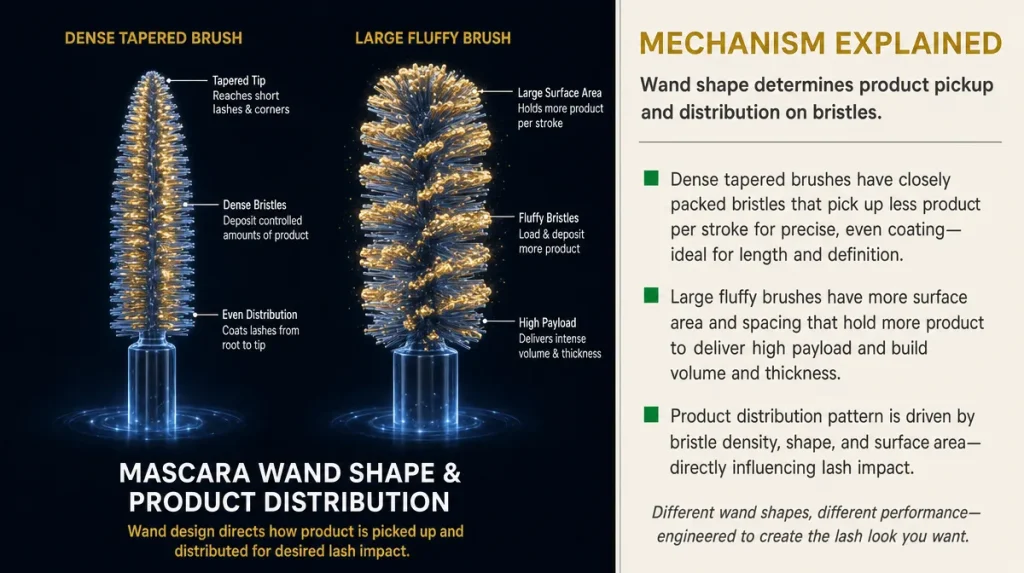
Before applying anything, look at the wand shape through the tube. A dense, slightly curved brush with short, closely packed bristles deposits product gradually and combs through as it goes. A large, fluffy, straight-sided brush deposits far more product per pass and struggles to reach the inner and outer corners evenly.
Run the wand once across the back of your hand. If a visible clump sits on the skin after a single stroke, that formula is already thick and will need a lighter hand, shorter strokes and more patience between coats. If the line looks thin and even, you have more room to build without gambling on clumps.
This is a genuinely useful two-second test to run in a pharmacy before buying, or on a mascara already in your bag before your morning routine. It tells you more about how a product will behave than the packaging claims ever will, because wand geometry, unlike marketing language, does not vary by market.
Applying In Layers Instead Of Coats
Most people apply mascara in one or two thick strokes from root to tip and call it done. Volumising formulas punish this approach because the wax needs air exposure to set between applications.
A better method: wiggle the wand at the base of the lashes first, holding it horizontally and moving it side to side for two or three seconds before drawing it upward. This deposits product at the root, where volume actually reads visually, rather than concentrating it at the tips where it simply weighs lashes down.
Wait roughly fifteen seconds. Apply a second, thinner pass only where you want more lift or separation, usually the outer corners. A third coat rarely adds volume; it usually adds clumps, because by the third pass the wax on the lash has already begun to set and new product simply sits on top rather than bonding.
The common mistake is treating this like painting a wall, more coats for more coverage. Lash coating behaves more like laminating layers of thin varnish: each layer needs to cure before the next goes on, or the whole thing smears.
Why Lashes Look Great At 8Am And Flat By 3Pm

Volume that disappears during the day is rarely about the mascara losing its hold. It is more often about the natural oils on the eyelid softening the wax film from underneath, particularly for people with naturally oily eyelids or those who apply moisturiser too close to the lash line in the morning.
A 2019 review published through the European Academy of Dermatology and Venereology’s general skin-care guidance noted that periocular skin produces sebum at a different rate to the rest of the face, and that residue from eye creams applied too close to the lash line can migrate onto lashes within a few hours.
The practical fix is sequencing: apply eye cream at least ten minutes before mascara, and keep it to the orbital bone rather than the lash line itself. If lashes still droop by early afternoon on humid days, that is a formula reaching the limit of its wax content in warmer temperatures, not a personal failure of application. Southern European summers, in particular, make heat-resistant formulation genuinely relevant, not just a marketing term.
Reading Ingredient Lists Without Falling For Buzzwords
Terms like “fibre technology” or “volumising complex” describe a category, not a guarantee. What actually matters on the ingredient list is the position of waxes (carnauba, beeswax, synthetic waxes) relative to film-forming polymers. If a wax sits high on the list, expect a thicker, more coating formula that will need the layering technique described above.
Fibres, when present, are usually nylon or rayon microfibres suspended in the formula to physically extend the lash tip. These genuinely add length, but they are also the most common cause of the “spider lash” look when applied too thickly or without combing through afterwards. A cosmetic chemist would point out that fibre-based formulas benefit from a clean-bristle comb-through immediately after application, while their wax content is still workable.
It helps to ignore claims about lash counts or percentage volume increase printed on packaging. These figures come from panel testing under lab conditions that rarely resemble daily wear, heat, humidity or the natural oils of real skin.
Storage And Shelf Life: The Mistake Almost Everyone Makes
Volumising mascaras dry out faster than lengthening ones because their thicker wax and polymer content oxidises more quickly once exposed to air. Pumping the wand in and out of the tube, a habit almost everyone has, pushes air into the formula every single time and speeds this up considerably.
The better habit is twisting the wand gently as you withdraw it, which draws product up without forcing air down into the tube. Most cosmetic chemists put the realistic shelf life of an opened mascara at three months, not because the formula turns unsafe exactly at that point, but because oxidised wax clumps and drags rather than coating smoothly.
A quick self-test: if the wand comes out with visible strings of dried product clinging to the bristles, or if the formula drags rather than glides on the first stroke of the day, it is past useful life regardless of how much product remains in the tube. Cold, dry winter air in northern Europe accelerates this further, so mascaras opened in October may need replacing well before the three-month mark if stored anywhere near central heating.
Removing Mascara Without Damaging Your Lashes
The most common long-term mistake is not application at all, but removal. Rubbing at volumised, heavily coated lashes with a dry cotton pad pulls at the lash follicle and can cause lashes to shed prematurely, something dermatologists see regularly in patients who describe thinning lash lines after years of heavy mascara use.
A damp micellar water or a dedicated bi-phase remover, held against closed lashes for ten to fifteen seconds before wiping, softens the wax film enough that it comes away with gentle downward pressure rather than friction. This single change in habit does more for long-term lash density than any product switch.
General guidance from Cosmetics Europe on eye-area product removal recommends avoiding rubbing motions specifically because of the thinness of periocular skin, a point worth taking seriously given how visible under-eye skin damage becomes with age.
Key Takeaways
Volumising mascara rewards patience more than product choice. The wand shape, the number of thin layers, the timing between coats and the way you remove it at night matter more than any formula claim on the box.
Most daytime lash droop traces back to skincare migrating onto lashes, not a weak mascara. Most clumping traces back to a second coat applied too soon, not a bad wand.
A mascara that seems to “stop working” after a few weeks is often simply oxidising faster than expected, particularly in centrally heated homes or hot, humid summers. Twisting rather than pumping the wand, and replacing the tube every three months regardless of how full it looks, solves more problems than switching brands ever does.
A Quick Checklist Before Your Next Application
- Check the wand shape and do the back-of-hand test before committing to a full face
- Apply eye cream at least ten minutes before mascara, kept away from the lash line
- Wiggle the wand at the root first, then draw upward in one motion
- Wait fifteen to twenty seconds between coats rather than layering immediately
- Comb through fibre-based formulas while the product is still workable
- Twist, never pump, the wand when withdrawing it from the tube
- Replace any mascara at the three-month mark, sooner if stored near heating
- Remove with a damp micellar pad held in place, never a dry rubbing motion
This article is for general information only and does not replace individual advice from a dermatologist or pharmacist.
Results and skin or lash response vary from person to person.